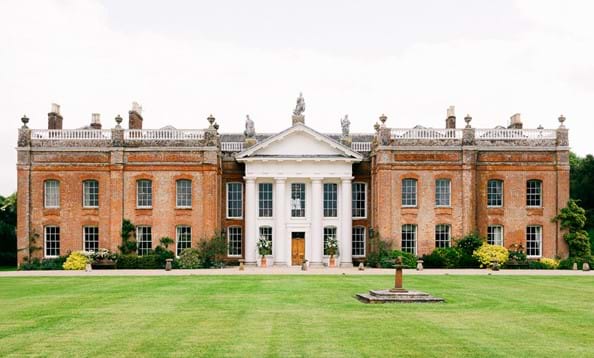


Avington Estate
A LEGACY OF ROYALTY, RESTORATION, AND OVER A THOUSAND YEARS OF ENGLISH HERITAGE
Nestled within the Itchen Valley and surrounded by Hampshire countryside, Avington’s story stretches back more than a thousand years. Once home to royalty, courtiers, and visionaries, the estate has evolved through centuries of change - each era adding a new chapter to its rich and remarkable history.
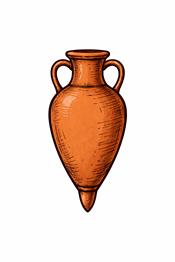
A Roman Settlement
It is believed that a settlement has existed at Avington since the Roman times. During different construction works at Avington, over many years, old Roman settlement objects, such as wines jars and pots, have been found under floorboards at Avington, indicating that there has been a settlement on the site since then. The Roman Empire ended in 476 AD. There is nothing documented about Avington until 961 AD.
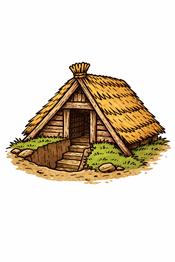
A Saxon Settlement
Part of the Avington Estate is called Beech Hill. It looks directly over the house and lake, and large earth mounds are visible denoting the large Saxon Settlement located on top of the hill, which the mounds surround. This part of the estate is a Scheduled Ancient Monument, a recognised site of national historical importance.
'Afintun'
(961-1545 AD)
‘Afintun’ was first mentioned as an estate in the reign of King Edgar of the Angles in 961 AD, when the house and 5 manses (clergy houses) were conferred to the Cathedral.
The name Afintun denotes that this was a place of extensive meadowland suitable for grazing cattle.
The Domesday Book contains records confirming that the Avington belonged to the Cathedral. It was assessed at this time to be worth £10, with ‘land for five ploughs, the demesne is for four ploughs and there are 8 villeins and 3 borderers. There is a Church and 3 serfs and 16 acres of meadows’.
The building would have been a medieval stone building. Until recently, it was assumed the original building had been demolished to allow for the red brick building today.
However, whilst undertaking plumbing works in 2025, the current owners (the Roach Family), discovered a large stone window below the first-floor landing, and it is now clear that many of the internal existing walls were actually the original external walls of a medieval stone Manor House. Other parts of the original medieval house can be seen, such as some cornerstones and a fireplace.
Whilst the documentation showed the existence of Avington, the discovery of the window affirms that the building at Avington House has stood for over 1,000 years.
In 1205 the house is documented as being held by the Prior and Monks of the Abbey of St. Swithun’s. They remained there until the reformation.
Avington in The Domesday Book
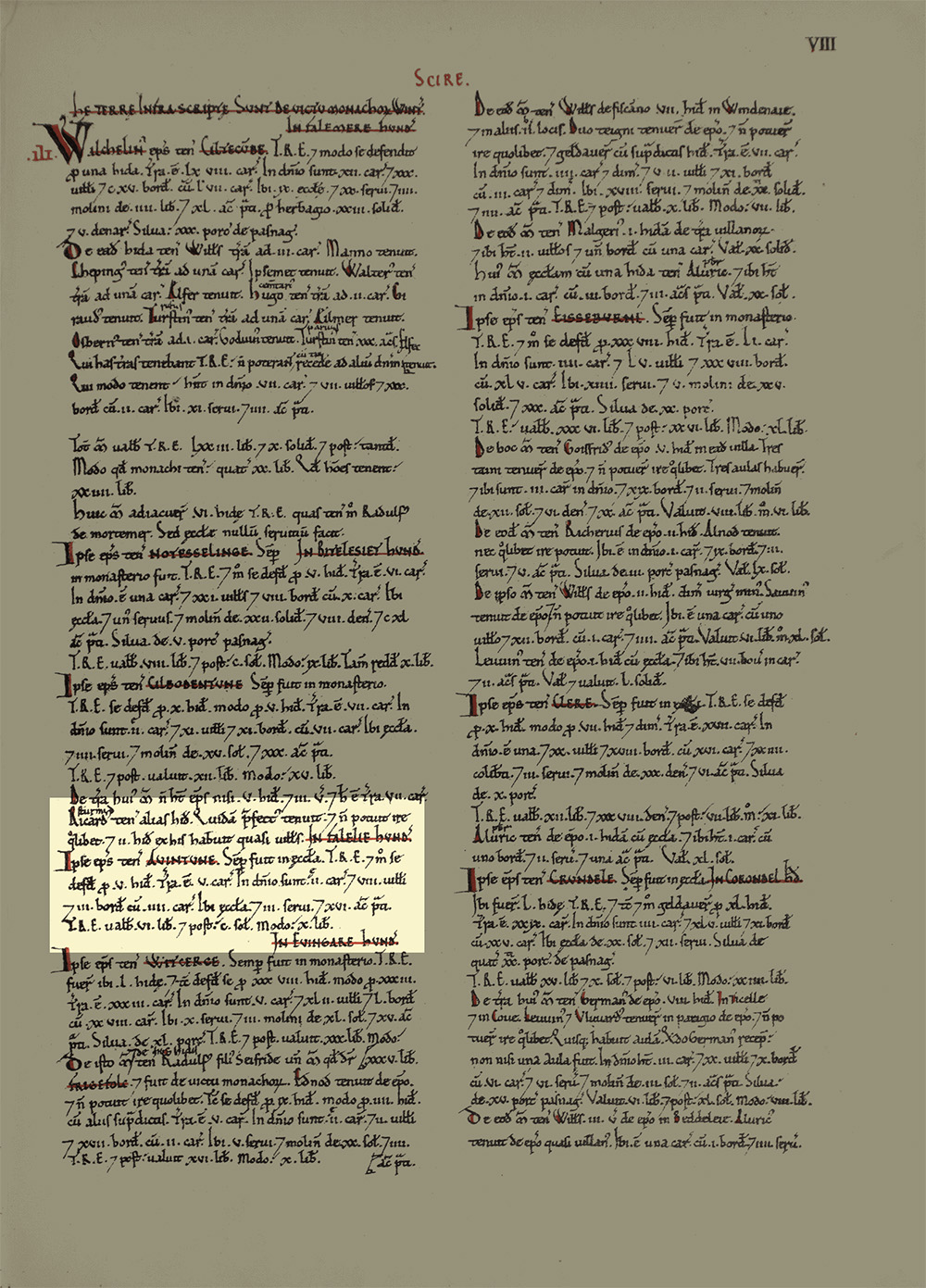
View the listing of Avington in The Domesday Book, a record of the Great Survey of England and parts of Wales completed in 1086 and commissioned by William the Conqueror.
The Reformation & the Creation of a Royal Residence
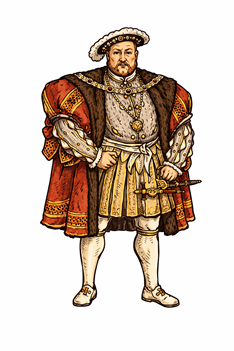
In 1545 King Henry VIII granted Avington to the Dean and Chapter of Winchester, taking it away from the Monks of St. Swithun and placing it into the hold of the Cathedral. However, as part of the Reformation, Henry VIII then revoked this grant to the Cathedral and Avington became Crown property.
In a twist of history, the descendants of Anne Boleyn, the second wife of Henry VIII who was executed, lived at Avington. Charlie Bullen (a descendant) was married to Sarah Hickson, whose family would later own Avington.
The Tudors
(1546-1665)
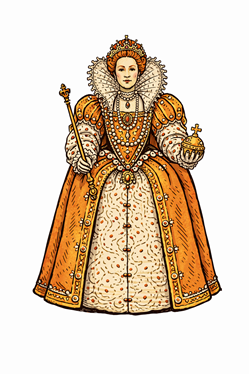
With Avington under Crown ownership, like other great estates, Avington was passed to members of the Royal Court for safekeeping, management, and regional rule. The ownership of Avington was transferred to Edmund Clerke, its first secular owner, (Clerk of the Privy Seal for Henry VIII and Elizabeth I).
Records show that Avington was sold to the Clerke family for £409 and 9 shillings and their family managed Avington for the Tudors. Elizabeth I eventually ascended to the Throne in 1558 after her release from the Tower of London, which was negotiated by Sir John Brydges (the 1st Baron Chandos). Today, a portrait of Elizabeth I, depicting her release from the Tower of London, by John Brydges, hangs in the dining room at Avington.
Reign of The Stuarts
(1603)
James I of England ascended to the Throne in 1603 and ruled until 1625, when he was succeeded by Charles I, who was executed in 1649. His son who was living in exile in the Palace of Versailles, returned to England as King in 1660. The Groom of the Bed Chamber to Charles II was Sir George Brydges (the 6th Baron Chandos), and Avington was given to the Chandos Barons in 1664 by the King.
Sir George Brydges added the service courtyard and the banqueting hall. The Chandos Barons commissioned the artist Antonio Verrio, the Baroque painter, to paint an exact replica of his masterpiece ceiling that he had painted in the state bedroom in the Palace of Versailles. This state room was used by Charles II whilst he was in exile, and it was repainted in the Ballroom at Avington at the request of the Monarch. It remains in near-perfect condition today.
Verrio’s works include Windsor Castle, Hampton Court, Chatsworth and Avington.
The Ballroom Ceiling
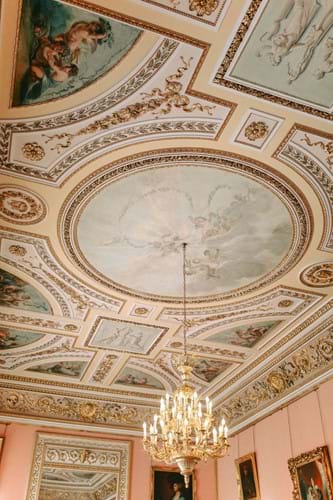
The ceiling painting in The Ballroom at Avington, by Baroque painter Antonio Verrio - an exact replica of the state bedroom ceiling at the Palace of Versaille.
The Reign of Charles II
(1660-1685)
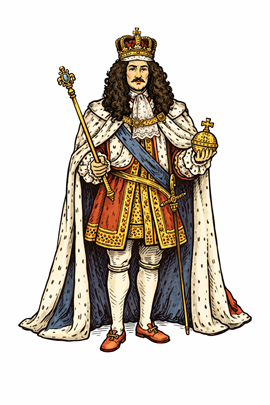
King Charles II commissioned the building of a Royal Palace at Winchester. During the construction, the King was unable to use the Residences in Winchester due to the Dean’s objection to his mistress, Nell Gwynn, so the King lived at Avington for 10 years with Nell Gwynn and their children. The Chandos Barons had remodelled Avington to reflect the King’s European Baroque architectural taste. The Avington House motto became “Fay ce que voudras” – as do as you will.
Various portraits of Charles I, Charles II and his family, and, of course, Nell Gwynn, hang on the walls of Avington.
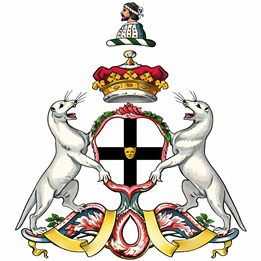
The Dukes of Chandos
(1719-1847)
The Chandos Barons continued to own Avington after the death of Charles II.
George Brydges drowned in 1713 trying to rescue his pet dog from Avington Lake. His son, also named George, became MP for Winchester and took control of the house. He died in 1751 and is buried in Avington Church.
In 1719, the Barons were elevated to Dukes and became the Dukes of Chandos.
Avington remained in the family, passing through various generations of Brydges Barons who became the Dukes of Chandos. The 3rd Duke of Chandos, James Brydges, was Lord Lieutenant for Hampshire for almost ten years; interestingly, the Hampshire Lord Lieutenants still celebrate at Avington today.
James Brydges made further improvements to the house, adding the lead figures of Minerva, Juno, and Ceres to the front of the house, as well as installing the fountain and sundial. James inherited swathes of property across London and Cannons Park but remained in Avington. James Brydges’ wife, Margaret, paid for the rebuilding of Avington Church, but she passed away in 1768 before it was finished; a memorial of her resides in the church today.
Avington continued to play party host to Royals, including King George IV and his long–term mistress Mrs Fitzherbert in the 1820’s. A coronation portrait of King George hangs in the ballroom.
Upon James Brydges’ death in 1789 he left the estate to his daughter, Lady Anne Elizabeth Brydges. She married Richard Earl Temple, the 2nd Duke of Buckingham, at age 16, and they assumed the names and arms of Brydges-Chandos in 1799. Avington remained under the ownership of the Chandos and Brydges family line until 1847, when the ownership passed to the Shelley family.
The Shelley Family
(1847-1951)
Sir Charles Shelley made many modernisations to the Avington estate, including installing a water supply and electricity to Avington, as well as a private telephone exchange, which prompted some unhappiness from the Postmaster General! His son, Sir John Shelley further advanced the house, including the building of the orangery and adjoining conservatories.
During World War I Avington was used by the US Army as a troop’s station. The House was unaffected by this.
During World War II Avington was emptied of its contents and many of the portraits were sent to America for safekeeping. The US Army used Avington as a headquarters for special operations, and, in the neighbouring Matterley Bowl, General Eisenhower (later the 34th President of the United States) addressed troops for the D-Day landings.
Lady Eleanor Shelley-Rolls, the heiress to the Rolls-Royce fortune, lived a long life at Avington and launched her hot air balloons from the South Lawn. Portraits and statues remain at Avington of Lady Shelley-Rolls. She was a founding engineering pioneer and founded the Women’s Engineering Society. She is buried in Avington Church. She married John Shelley and a condition of the “Rolls Will” was that the Rolls name “continued to be held by heirs” so John Shelley became Sir John Shelley-Rolls. It was her fortune that continued to advance Avington with the orangeries, library, and other modernisations.
Avington never recovered from the war, and it was divided into lots and sold off by the Percy Shelley Estate (the poet who was left the estate by John Shelley-Rolls, his brother). The main House was sold in part to Lt. Col. Hickson and his family in 1951 at auction.
Avington During the First World War
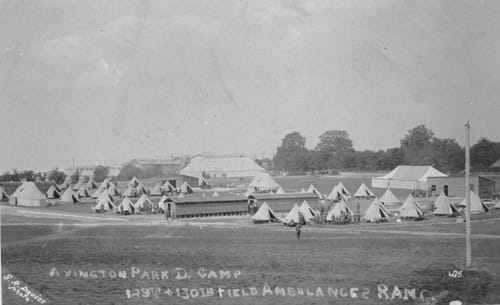
A postcard showing an image of the US army camp at Avington Park in the first world war, dated 12/9/1915.
Image courtesy of Hampshire & Solent Museums
The Hickson Family
(1951-2020)
During the Hickson tenure, parts of the previous estate were repurchased, including the lake and various buildings. The Hickson Family restored the main state rooms, which suffered from the effects of war neglect, along with the orangeries, the roof, and many other aspects of the house. They proved to be excellent custodians of the main state rooms.
The house was divided into 12 apartments in the 1950’s with the central state rooms used for hospitality events. By the 1990’s, all apartments and buildings were owned by the Hickson Family, who then rented each, along with other properties to support the estate, alongside functions and events. Records show that the first paid wedding was in 1953.
The Roach Family
(2020-Today)
Becoming only the fifth family to occupy Avington in a 1,000 years, the Roach Family, bought the estate from Sarah Bullen (daughter of Hickson) after first enquiries some 25 years before, patiently waiting for the opportunity. A major refurbishment project took place between 2020 and 2021 to restore the House with much-needed investment in heating, electrical, and decoration to the house and the grounds. Parts of the property were in neglect, including the so-called Nell Gwynn Bath House, which was classified as a Building at Risk by English Heritage. The house is now fully restored and is in fine condition for future generations.
Avington is now a viable working family estate and the family has re-acquired former sold-off parts of the estate, including land, rivers, water-meadows, the historic fishery, and other buildings, and these together offer visitor accommodation, functions, and events; the income from which supports the now restored 300-acre estate. The estate is a natural retreat in Hampshire where the architectural masterpiece of the house meets its stunning parkland landscape. It is regarded as one of the most beautiful and best-kept estates in the country.
A portrait, bought at auction prior to the Roach Family ownership of the House, showing Charles II as a boy in a red tunic, was hung in the Ballroom in 2020. Subsequently, a year later, whilst researching papers and photographs from 1880 left by previous owners, it was found that the same portrait had not only returned to Avington but had been rehung in the same place, all by chance. Charles II had returned to his favourite home.
In 1685, Charles II’s final words on his death bed to his brother James II and his courtiers, were “don’t let my Nellie starve” so a portrait of Nell Gwynn now hangs over the fireplace in the dining room at Avington, so Nellie can admire the food.
In 1825, the Famous English writer, William Cobbett, wrote of Avington in this famous book Rural Rides “Avington is one of the very prettiest places in Hampshire” – it certainly remains the case.